
How to Prepare for SSC, Railway and State Exams — A Complete Study Plan for Beginners
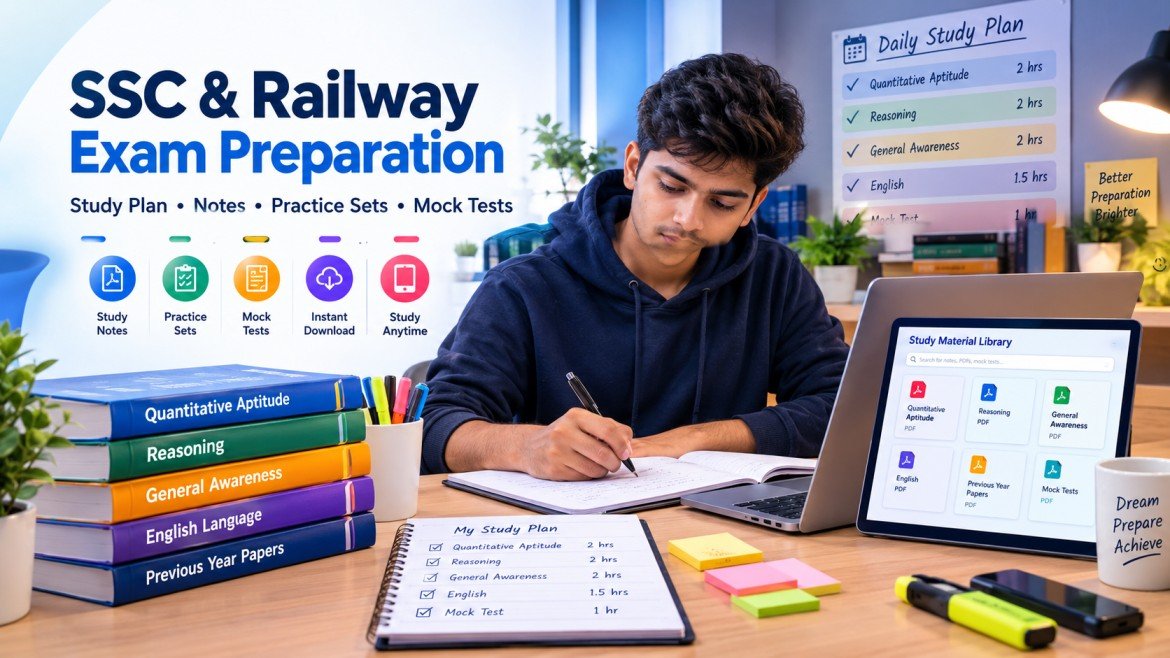
Table of contents
- Before You Start Preparing
- Step 1: Understand the Exam Pattern and Syllabus Thoroughly
- Step 2: Build a Subject-Wise Strategy
- General Knowledge
- English
- Mathematics and Reasoning
- Step 3: Build a Realistic Daily Routine
- Step 4: Prioritize Practice and Mock Tests
- Step 5: Make Revision Part of Your Routine
- 5 Common Mistakes Beginners Make
- Conclusion — Consistency Is the Real Secret
Before You Start Preparing
Every year, lakhs of students begin preparing for competitive exams like SSC, Railway, JSSC, and JPSC, but many fall behind simply because they don't have a clear study plan — they study one subject one day and a completely different one the next, with no real structure.
In this post, we'll walk through a practical, step-by-step approach to help you organize your preparation — whether you're a complete beginner or you've been studying for months without seeing results.
Step 1: Understand the Exam Pattern and Syllabus Thoroughly
Before you start studying, write down the complete syllabus and exam pattern of whichever exam you're preparing for — how many sections there are, how many marks each section carries, and whether there's negative marking. Starting your preparation without this is like setting out on a journey without a map.
Tip: Print out the syllabus and tick off topics as you complete them — it shows real progress and keeps you motivated.
Step 2: Build a Subject-Wise Strategy
Most competitive exams (SSC, Railway, JSSC) share common sections — General Knowledge, English, and Mathematics/Reasoning. Each subject needs a different approach:
General Knowledge
Studying a little bit of GK every day is far more effective than cramming everything at once. Along with static GK (History, Geography, Polity), follow Current Affairs daily as well.
English
For English, your grammar fundamentals need to be solid, and you should learn new vocabulary daily — exams tend to repeat the same high-frequency words, so focusing on those is a smart strategy.
Mathematics and Reasoning
These are practice-heavy subjects — the more questions you solve, the more your speed and accuracy improve. Memorizing formulas isn't enough; you need practice applying them.
Step 3: Build a Realistic Daily Routine
The perfect routine isn't the one that shows the most study hours — it's the one you can follow consistently. A simple example:
- Morning: 1 hour of GK/Current Affairs
- Daytime: 2 hours of Maths/Reasoning practice
- Evening: 1 hour of English (Grammar + Vocabulary)
- Night: Revise what you studied during the day + attempt one short mock test or quiz
Start with small, achievable goals — studying 2 hours out of a 6-hour plan is far worse than completing a well-planned 2-hour session in full.
Step 4: Prioritize Practice and Mock Tests
Studying alone isn't enough — until you actually solve questions, you won't develop the time management and accuracy needed for the exam. Make it a habit to attempt at least one topic-wise quiz every day.
If you're just getting started, try these free resources:
- SSC English PYQ — 5 years of previous year questions
- SSC Vocabulary Vault — high-frequency words
- Science GK Practice Quiz
- Jharkhand GK Practice (for JSSC/JPSC)
Step 5: Make Revision Part of Your Routine
It's common to forget what you studied today if you don't revise it. Set aside one day a week purely for revision — don't study anything new that day, just go back over what you covered the previous week and test yourself on it.
5 Common Mistakes Beginners Make
- Starting without a plan — studying whatever topic feels interesting instead of following a systematic approach
- Only making notes, never practicing — exams require you to solve questions, not just read notes
- Ignoring Current Affairs — this carries significant weight in the GK section
- Not clearing doubts — skipping concepts you don't understand creates bigger gaps later
- Avoiding mock tests out of fear — scoring low at first is normal; that's exactly how you improve
Conclusion — Consistency Is the Real Secret
Preparing for a competitive exam is a marathon, not a sprint. The most important thing is to study a little every day, consistently, following a clear plan. If you follow the steps above and practice regularly, you will see real progress.
To take your preparation further, explore our free study material and premium e-books — subject-wise, well-organized content that makes your preparation easier.
If you have any questions, feel free to reach out on WhatsApp: +91 99398 78821